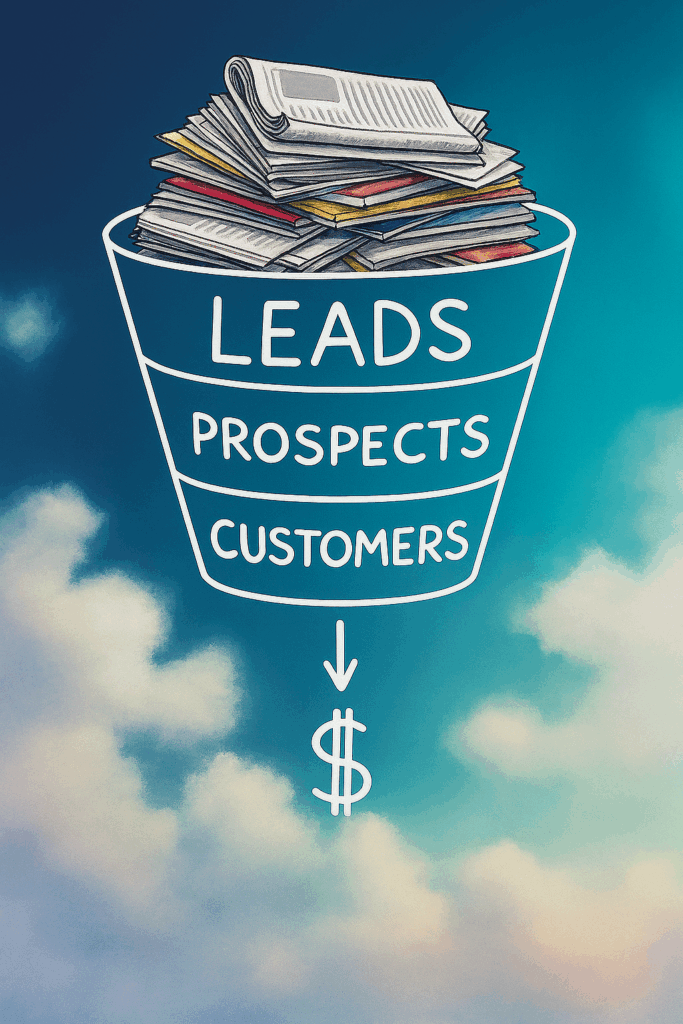
Recently, a client asked me: Will PR generate leads?
The short answer is, yes! A public relations campaign can help individuals and organizations increase visibility and establish themselves as recognized experts, while also generating leads.
But does every prospect see every newspaper, magazine, blog, podcast, panel, presentation, or event you are featured in? The answer is, probably not.
That’s why we need to reach them wherever they are. And we do that through promotion of our own press.
If you’ve appeared in an article, program, or podcast, there is more we need to do.
In today’s post, I’ll share the exact strategies I’ve used myself, and on behalf of my clients, to successfully generate real leads and sales from PR.
The First Step in the Sales Lifecycle
PR and strategic communications increase your visibility and introduce you to possible clients, partners, and communities.
The best part? Letting the media tell your story and position you as the expert without you having to say it yourself.
This is an important first step, since people must hear about you, and trust you, before they buy from you.
Get featured in a top-tier national newspaper or on a high-visibility podcast, and you get instant credibility.
Rinse and repeat enough times, and you become a leading provider in your industry.
What to Do Next
Once you have a few published placements, how do we increase leads?
The following is a list of forums that likely already exist in your day-to-day, and can be massively effective for business reach. Your next step? Start promoting your coverage immediately in the following forums:
Social Media: Post the coverage on all of your social channels! Sharing press coverage on social platforms extends its visibility and credibility to your professional network and potential customers. A well-crafted post with context or a personal takeaway makes the mention feel authentic and sparks engagement, turning media wins into conversations.
Personal or Company Blog: Republishing your press mention on a blog allows you to expand on the story with your own insights. This not only boosts SEO value but also positions your brand as an active thought leader.
Newsletter: Including PR mentions in your company newsletter reminds your audience of your growing credibility while keeping subscribers informed and engaged. It transforms earned media into content for your audience, communicating that you are a leader in the field.
Proposals, Presentations, and Other Business Development Communications: Adding “As Seen In” logos, headlines, or pull quotes to client-facing materials instantly strengthens your authority. When competing for business, these third-party validations can be a differentiator that tips a decision in your favor.
Press Page: A dedicated press page serves as a centralized library of your media mentions, giving journalists, clients, and investors an easy place to see your credibility. It signals transparency and momentum, showing that your story is continually being recognized.
And a few other (unexpected) places to include it:
Email Signature: Your email signature is seen dozens (if not hundreds) of times per week by prospects, clients, and partners, making it prime real estate for promoting press mentions. A simple “In The News” link or banner subtly reinforces credibility with every message you send. Over time, this repetition builds trust without feeling promotional.
Email Marketing Campaigns: Incorporating press mentions into dedicated or ongoing email campaigns extends their reach well beyond the initial publication. Highlighting coverage in newsletters, nurture sequences, or special announcement blasts reminds subscribers that third parties recognize your expertise. This adds social proof to your marketing, making your offers more persuasive.
Cold Outreach: This tactic is a powerful way to secure new business. Referencing media coverage in cold emails or LinkedIn outreach can instantly elevate your credibility with prospects who don’t yet know you. A line like “We were recently featured in [Publication] for our work in…” positions you as vetted by a trusted third party. It lowers skepticism and makes prospects more likely to engage with your message.
There you have it. Utilize all these forums regularly for a month and let us know what kind of results you are getting.
Keep The Momentum Going
With every new media placement, feature story, speaking engagement, or other accolade comes an opportunity to connect.
But in addition to business leads: focus on media leads as well.
Conduct regular outreach to editors, writers, and influencers in your space to keep a pipeline of opportunities coming your way.
Take the next step by promoting your PR results through the channels outlined here to maximize your visibility and generate real leads.
It brought up the critical question that faces PR professionals today: can we use AI and if so, how?
Go ahead and run your next sales presentation, marketing document, or blog post through ChatGPT or Claude’s capable virtual hands to make it longer, shorter, or to clean it up.
However, while AI has numerous positive applications, utilizing it to answer journalists’ questions and requests for commentary is both unethical and detrimental to everyone involved.
Here are the three biggest reasons why PR companies and professionals should avoid using AI to generate responses for reporters:
First, inaccurate or missing-the-mark commentary can harm you. We don’t know if a quote generated by Al is true, false, ridiculous, or lacking context that Al might have missed. True industry experts have strong, original opinions and ideas. Those who are serious about thought leadership aren’t going to want an Al tool answering hard questions for them.
Second, it harms relationships with journalists. Oftentimes, journalists can tell if an answer is AI-generated (hello, too many emdashes and metaphors like elevating such-and-such to new heights). Journalists rely on expert sources to deliver honest insights from the front lines of the industry they are covering. If they get wind that you used Al to create an answer, chances are you will be quietly banned from their publication and possibly others.
Third, it harms our understanding of the world. Journalism helps us understand our industry and communities better. We make decisions based on what is happening in the news, from the economy and politics to the job and housing markets and more. Misinformation undermines quality journalism and ultimately hinders our understanding of critical issues.
In short: don’t submit unoriginal commentary to a journalist or publication created by an Al tool under the auspices of being from yourself or another human.
AI is a powerful tool, but there is no substitute for a human’s perspective. Think of it this way: what will be more interesting, hearing about a friend’s personal travels to Japan, or reading about Japan off the web? A bot scraping the web for content isn’t even going to come close in terms of providing true insights, personal stories, or wisdom from the front lines.
Most importantly, talking to reporters is a golden opportunity to share the deep knowledge, skills and insights you bring to the table. Why not make the most of it?
Public relations often hinges on newsworthiness—new projects, service offerings, product launches, funding rounds, big hires, or viral campaigns. But what if you don’t have any major news announcements?
In today’s post, I’ll share how to generate attention for yourself and your brand even when there’s no hard news to pitch—and keep you and your brand in the media limelight.
Leverage Thought Leadership
When it comes to thought leadership, you are the story. Thought leadership builds trust, positions you as an authority in your field, and keeps your brand relevant, even when you have no traditional news to share. Here are a few of the simplest, most effective ways to build thought leadership:
Write guest articles or op-eds: Share your perspective on trends, industry challenges, or lessons learned. Publications are always looking for credible expert voices.
Participate in podcast interviews: Hosts are often searching for fresh guests. Share your story, your mission, and actionable advice.
Voice your perspective consistently: Whether it’s LinkedIn, a business blog, or newsletter, reflect on your journey, share behind-the-scenes of your work, and offer helpful insights that truly help your clients and community.
Turn Your Process Into Content
Regardless of your industry or role, your philosophy and approach to your work are unique assets you bring to the table. Turn your insights into compelling content that answers common questions and gives customers value. Here are some examples to start with:
“How To Skyrocket Your Success in [Your Industry]”
“Key Considerations for Hiring a [Your Role/Industry] in 2025”
“Top 3 Mistakes [Your Client Type] Makes When [Problem You Solve]”
Customize these ideas for your industry to make them optimally appealing to your target audiences. These can also serve as lead magnet ideas to convert website visitors into an email list.
Jump on Trending Topics (Thoughtfully)
If there’s a relevant news story, trend, or cultural moment in your industry, offer your take, whether it’s in the form of a blog post or a quote for a journalist. You may also proactively reach out to relevant media to offer your insights. Some ideas:
Reach out to relevant journalists covering these types of topics/trends in your industry, offering your perspective for any articles they are working on.
Use tools like HARO and Featured to find daily opportunities.
Share your insights on this timely topic with your audience, whether LinkedIn, a company blog, or another social platform.
Create Your Own Media
Recently, I worked with a group in the construction industry whose work was fascinating—though to them it seemed ordinary, and they struggled with marketing in general as a result.
After I met with them, they were surprised to learn that they already had more than enough material such as arresting images (views from tops of buildings!) and behind-the-scenes insights to create content that would attract prospective clients and partners, and provide value to the industry.
This may be true for you as well.
Start here: What part of your job or industry is most interesting or surprising?
Bonus tip: Identify areas that would help a customer make a decision about working with you. Some ideas might include:
Host a live Q&A or webinar.
Launch a behind-the-scenes video series.
Interview other industry leaders on your blog or social channels.
Start a newsletter with your take on what’s happening in your space.
These are controllable platforms that showcase your expertise, personality, and value.
Showcase Your Clients’ Wins
How have you helped customers? What has your product or service done to make their work and life better? Create content around client wins to showcase your value and what others can expect when they work with you. Try these ideas:
Share customer success stories and testimonials on your website to showcase your brand’s credibility and build trust.
Interview clients for your newsletter or social media content with a “before and after” appeal.
Create content, such as an interview series, interviewing successful clients and showcasing their wins.
This not only generates goodwill but also increases your credibility and shares your clients’ success stories with the world.
Position Yourself as a Resource
One of my favorite clients, an attorney, loves answering questions about their industry; they would do it all day long if they had time! Luckily, you don’t have to do it all day long to be effective. Sharing insights enthusiastically shows a deep amount of knowledge and goodwill. You can:
Answer common questions in your industry.
Post “how-to” tips on social media.
Create downloadable checklists or templates to help with common issues.
Some people have built entire channels using this advice. This tactic alone may build credibility, trust, and a steady stream of interest.
Consistency is Critical
Even when there’s no “news,” you are the news. The value you add, the education and inspiration you provide, and the solutions you can offer are what builds real, lasting “buzz” for a brand.
Have you tried any of these tactics? Let me know in the comments!
Public relations has long been misunderstood as a game of who-you-know. For decades, the image of the well-connected publicist calling up their favorite journalist to “get a story placed” defined how people, both inside and outside the industry, viewed PR. But in today’s media and attention economy, relationships alone are not enough. At its core, effective public relations is about strategy and storytelling, not simply maintaining a contact list.
The Limitations of Relationship-Based PR
Of course, having strong media relationships can open doors. A reporter is more likely to read your pitch or return your call if you’ve built trust over time. But relationships do not guarantee placement, especially in an era when editorial standards are high and journalists are overwhelmed with dozens of pitches each day. Reporters are accountable to their editors, their audiences, and increasingly, analytics. They care about relevance, angles, and evidence, not who sent the email.
The truth is, no matter how friendly you are with a journalist, they won’t cover a weak story. A reporter relationship might get your pitch read, but it won’t get your story told unless it’s compelling, timely, and strategically positioned within the broader news cycle. In this way, relationships are a tactic, not a strategy.
Strategy: The Foundation of Effective PR
Public relations is ultimately a strategic discipline, rooted in business goals and reputation management. A successful PR campaign doesn’t start with an email to a journalist—it starts with a deep understanding of the client’s objectives, audience insights, market dynamics, and the cultural moment. Strategy determines why we’re communicating, who we’re trying to reach, what we’re trying to achieve, and how we’ll measure success.
Whether it’s shaping a thought leadership platform, managing a crisis, launching a product, or repositioning a brand, PR practitioners must think like strategists: aligning communications with long-term vision and business value. Without strategy, PR becomes reactive, fragmented, and ineffective—even with the best media contacts.
Storytelling: The Engine That Drives Attention
If strategy is the roadmap, storytelling is the engine that drives results. People don’t remember taglines or boilerplates—they remember stories. In a crowded, skeptical, and fast-moving media environment, the most powerful way to build connection and credibility is through narrative. This means finding the emotional hook, the human impact, the unexpected angle—something that resonates beyond jargon or corporate messaging.
Great PR professionals act as translators. They take complex or technical information and turn it into narratives that are accessible, relevant, and shareable. They frame company milestones not as press releases, but as moments in a larger story. And they do so not just for media, but for employees, investors, partners, and communities.
In this sense, storytelling is not a soft skill; it’s a strategic asset. The right story can shape public perception, attract talent, influence policy, and drive growth. And in a world increasingly shaped by narrative—across social platforms, podcasts, newsletters, and digital outlets—storytelling is no longer optional. Do it, or risk getting left behind.
Utilizing PR For Business Results
Today’s most effective PR professionals are not just media go-betweens. They are strategic advisors, brand architects, cultural analysts, and narrative builders. They understand not only how to get a story placed but also why it matters, what it means for the brand, and how it will resonate with the audience. They work hand-in-hand with executives, marketers, legal teams, and creatives to make communications not just visible, but meaningful.
As the media landscape continues to evolve, this shift from “who you know” to “what you say and why” will only become more critical. PR is no longer just about getting into the news. It’s about earning attention by delivering clarity, credibility, and connection through smart strategy and compelling storytelling. When done well, PR can yield significant business results.
At a recent new client kick-off meeting, I asked the company what results they got with their last PR firm since I hadn’t found anything in my research.
It was a curious situation, seeing as this client does impactful work and has global offices. They responded that they’d had coverage in a handful of small, niche publications that don’t pertain to their target audiences.
Upon closer review, the “coverage” was simply a press release picked up on a handful of irrelevant websites. How could an organization work with several PR firms and get zero meaningful results? Yet, business owners often tell me this is not unusual.
I won’t let that happen to you. In today’s post, I want to share what you can and should expect from a PR partner:
1. Regular publicity opportunities
Media coverage is the cornerstone of any PR program. Your PR representative should regularly deliver opportunities to be interviewed by journalists and content creators on stories germane to your industry. Additionally, they should provide thought leadership opportunities, such as contributing an article, hosting or being a guest on a program, writing a book, delivering a talk, or keynoting an event, with tangible results that appear publicly across the web and prominently amongst your target audiences.
2. Messaging and positioning advisory
Articulating and fine-tuning the client’s brand values and messages is a critical component of any PR program. Whether you’re interviewed for one minute or one hour or talking to a potential client or investor, the messaging process will help you deliver key information about your business and offerings in an easy-to-digest and compelling manner. This process will also help you figure out your interview strategy, as opposed to delivering “reactionary” answers.
3. Business development and lead generation
Positive visibility and exposure for your brand are fundamentally good for business development. Some clients become the most famous providers in their industry with many high-visibility press mentions and speaking engagements; others need to be on the right podcasts and programs with longer-form opportunities to appeal to their target audiences. The right PR team will work collaboratively with the client’s team to utilize PR for business development and lead generation.
If your PR person does not provide all three of the above deliverables, you should find someone who will.
As for the client who had no results with other providers, we secured significant media opportunities for them within the first month.
Regardless of your industry, what stage your business is in, or what has happened in the past, an effective PR team should be able to help you with the abovementioned issues—and take your business and brand to the next level.
Recently, a PR colleague asked me an interesting question: “Should I pay for a press release service?”
She was trying to promote her entertainment industry client, whose latest work wasn’t getting much attention.
“What do you hope the press release service will accomplish?” I asked.
She expressed sincere concern about getting the client top-tier media coverage and the recognition and commercial success they deserve.
We can all relate to this sense of urgency, wanting our own (or clients’) work and success stories to become famous and break the internet.
This is where a paid newswire service seems like a possible solution, promising an immediate or semi-immediate publication of your news.
But will it truly help you reach your goals?
First, let’s discuss what a press release distribution service does.
What does a press release distribution service do?
PR Newswire, a popular press release distribution service.
A press release distribution service publishes your announcement (written by you or a publicist you hire) on its website and distributes it to news networks.
Press release distribution services will pretty much publish anything within broad guidelines, i.e. anything legitimately business related and nothing below board.
Typical announcements that companies deem worthy of an investment, which can cost as much as $1,000 or more per announcement, can vary significantly.
Your press release can announce significant business news, a small update, or anything in between.
Whether about a new product or service, a round of funding, strategic partnership, or such hard-hitting journalism as a leading soda brand claiming that Mountain Time is their Official, Unofficial Time Zone, there is a press release distribution site that will publish it.
At the end of the day, you can expect your press release to be posted on their site, and will likely get picked up by other sites as well.
Some releases I have issued on behalf of my clients have landed on Wall Street Journal, Business Insider, Associated Press and Yahoo News and other seemingly top-tier media sites.
The caveat is that the releases appear in a “sponsored” section on the site, which is the Siberia of journalism.
The biggest problem with press release distribution services
This is what press release distribution services don’t tell you:
You could pay thousands for a press release distribution package, and your releases still wouldn’t (couldn’t) be found organically by the average reader on the site.
They “live” on some authentic media sites but do not appear when a visitor goes to the site.
You can technically say you were featured on the site, but it is no different than placing an ad, except an ad would ostensibly reach actual humans. The pages that house the press releases are different than the editorial, or real news, section.
Do journalists care about press release distribution services?
The other problem is, do these sites reach human journalists—and do they care?
Many services promise that your news will get delivered to journalists covering your industry. I set out to verify this claim.
After speaking with a journalist from a top-tier publication to verify this claim, what they said surprised me:
“Yes, I review an email of headlines and email from them periodically, that has a bunch of news releases in it.”
However, the journalist continued, “Can’t say I read it thoroughly. But I do search announcements sometimes to see what a company said about such and such.”
This means that your news does have a chance of getting in front of journalist contacts, however, it is important to note the context of how your release lands in front of the journalist.
While technically the reporter’s “industry,” this laundry list of headlines are largely irrelevant to this journalist’s actual beat.
The short answer is yes, some of these services deliver on their promise to get your press release in front of journalists.
But if you received this list above, would you have the time and energy (and eyesight) to go through it?
For a limited budget, is a PR campaign or a press release distribution service more effective?
When executed properly, a PR campaign will promote and publicize your brand across print, digital, and mobile media and can positively impact your bottom line.
Journalists will interview and publish stories and content about you and your brand. This positive information will make you rise to the top in searches and become your industry’s go-to provider and leading expert.
A press release distribution service will simply publish the document you provide them and circulate it to various “news” sites, but it is unlikely to be seen by actual humans.
The only way people can see it is if they are looking for it specifically. This fact makes it difficult for potential clients, partners, investors, and stakeholders to find your press release.
When should I use a press release distribution service?
Despite my critical viewpoint, there are still times when a press release distribution service can be useful in a PR campaign.
Here are the two reasons I would recommend a press release distribution service:
If the announcement isn’t newsworthy in the traditional sense—like a major transaction, product launch, partnership, or other significant business event—or journalists have already passed on it, you might still want or need to publish the information.
If there is a legal mandate to publish your release. Some publicly traded companies may be required to publish a release as part of Regulation Fair Disclosure. Using a press release distribution service is a way to satisfy these requirements.
Which press release distribution services would you recommend?
BusinessWire, another popular press release distribution service.
I generally don’t recommend utilizing a press release distribution service unless my client falls into one of the above categories.
If you fall into this category, there are plenty of press release distribution services. I’ve compiled a list of the nine most popular ones below:
PR Newswire: Blue-chip brands like Microsoft, Google Cloud, and Visa all distribute press releases using PR Newswire, making it one of the go-to options for corporate press release distribution. I’ve used this service countless times throughout my career: it’s expensive, and its salespeople are high-pressure. However, it does work well for a press release distribution service. While they don’t publicly disclose pricing, in my experience, a single press release will start at around $1,000 ($805 for the release and a $195 membership fee) and more for additional word count and images.
Business Wire: Toshiba, Accenture, and Citibank UK utilize this financial services-focused option, which bills itself as “distribution for PR and IR professionals” and “the global leader in press release distribution and regulatory disclosure.” Pricing starts at around $950 per release.
GlobeNewswire: Promises to “reach global audiences, monitor brand sentiment, send press releases, secure media coverage, and measure success.” It starts at $195 per release.
PRWeb: This low-cost cousin of PR Newswire will “leverage the industry’s leading, most sourced press release distribution network in the world.” I’ve used PR Web many times over the years. It’s simple to use and affordable, starting at $110 a release.
Newswire: Promises to reach thousands of online, local, regional, national, international, and industry media outlets, starting at $349 a release.
EIN Presswire: Calls itself “the world’s leading press release distribution service; reach millions with one click.” Starts at $99.95 per release.
24-7 Press Release: States “24-7 Press Release Newswire has been in business for over 18 years,” and “we post news for include major hotels (Holiday Inn, Hampton & Fairfield Inn & Suites), Church’s Chicken, Fishbowl, and NASA to name a few.” Starts at $49 per release.
PR.com: They say, “Over 250,000 companies, both big and small, have trusted PR.com to help grow their business. ” It reaches “thousands of media outlets, journalists, influencers and websites; social media; major news outlets’ newsrooms; plus more.” It starts at $60 per release.
PRLogoffers free press release and press room hosting and free search engine distribution. If you believe you get what you pay for, an upgrade to distribute with PR Newswire is available for $339, which seems like a decent deal. Posting a single release is free.
In short, there is a time and a place for a press release distribution service.
Some PR firms encourage their clients to utilize press release distribution services every time the wind blows because they may count these placements as pickups. They justify this as being “good for SEO.”
I never count press release distribution services as placements. And SEO will improve when reputable news sites include you and your brand in their content—far more than flooding the web with press releases ever would.
Summary
What did I tell my colleague who wanted to know if she should try the press release distribution for her entertainment industry client?
Here’s my take: Her client had enough clout to secure top-tier media coverage without using any distribution service. She had to put in the time and hard work of researching and pitching appropriate writers, editors, and outlets. I gave her a few angles, which I felt were compelling enough to secure a significant feature story and television interview.
She was also interested in trying a press release distribution service, so I gave her a contact to try one of the above services for free (the company had sent me an offer). I will report back soon with the results of both efforts.
In summary, I recommend focusing on a PR campaign that includes media opportunities to boost your business visibility and reach your target audience. The occasional press release distribution service can supplement these efforts.
In the era of digital transformation, professional services firms face unique challenges and opportunities in managing their corporate reputation. From construction and design, to legal, management, marketing and consulting firms, professional service providers must navigate a new and volatile landscape. This article explores how professional services firms can effectively manage their reputation—and increase customer satisfaction, retention and leads—in the digital age.
The digital age has transformed how professional services are delivered, marketed, and perceived. Clients now expect:
A client-centric approach to all aspects of service delivery
Instant access to information and expertise
Transparent pricing and reporting
Digital platforms for collaboration and communication
Thought leadership content available online
The Power of Online Reputation
For professional services firms, reputation is everything. In the digital age:
Potential clients often research firms online before making contact
Reviews, ratings and online content can significantly impact a firm’s image
Thought leadership content serves as a key differentiator and reputation builder
Key Strategies for Digital Reputation Management in Professional Services
Here’s what to do next in order to build and improve upon your—and your company’s—reputation:
1. Establish a Strong Online Presence
Develop a comprehensive digital footprint that showcases your expertise:
Create a professional, user-friendly website with clear service offerings
Maintain active profiles on relevant professional networks (i.e. LinkedIn)
Develop a content strategy that demonstrates thought leadership
2. Leverage Thought Leadership
Position your firm as an industry leader through:
Inclusion in news media articles and programs as an expert
Regular publication of insightful blog posts, white papers, and articles
Webinars and podcasts featuring your expertise
Participation in industry forums and discussions
3. Manage Online Reviews and Ratings
Actively manage your firm’s online presence:
Encourage satisfied clients to leave positive reviews
Respond professionally to all reviews, both positive and negative
Address negative feedback promptly and constructively
4. Develop a Crisis Management Plan
Prepare for potential reputational threats:
Identify potential crisis scenarios specific to your practice areas
Establish a crisis response team with clear roles and responsibilities
Develop pre-approved messaging templates for various scenarios
Train key personnel in crisis communication
5. Integrate PR with Your Overall Marketing Strategy
Ensure your PR efforts align with and support your broader marketing goals:
Coordinate PR messaging with your content marketing calendar
Use PR placements to support and amplify marketing campaigns
Leverage PR-generated content in your email marketing and social media efforts
Ensure your sales team is aware of PR activities to support their outreach efforts
Next Steps to Consider
Delivering a Best-In-Class Service Offering
A best-in-class service that provides transformative results to the client is the best marketing tactic. Do this by:
Shifting to a client-first approach at your company
Collaborating with clients on creative content (i.e. articles, video interviews)
Creating engaging case studies for use in business development
Requesting referrals—and offer them as well
Increasing client retention and generating leads utilizing the tactics above
Balancing Confidentiality with Transparency
Professional services firms must navigate the delicate balance between:
Maintaining client confidentiality
Demonstrating expertise through case studies and success stories
Being transparent about firm operations and practices
Managing Partner and Employee Online Presence
In professional services, individual reputations often contribute significantly to the firm’s overall reputation:
Develop guidelines for personal brand management
Provide training on professional online conduct
Monitor and manage the online presence of key personnel
Adapting to Rapid Technological Changes
Professional services firms must stay ahead of technological advancements:
Showcase adoption of innovative technologies in service delivery
Demonstrate understanding of how technology impacts clients’ industries
Address potential concerns about AI and automation in professional services
Maintaining a Consistent Brand Across Multiple Channels
With multiple partners and practice areas, maintaining a consistent brand voice can be challenging:
Develop clear brand guidelines for digital communication
Implement approval processes for public-facing content
Ensure consistent messaging across all digital platforms
Summary
In the digital age, reputation management for professional services firms requires a proactive approach, while maintaining a client-first perspective. By embracing digital platforms for thought leadership, prioritizing client needs, and preparing for potential crises, firms can build and maintain a strong reputation that resonates with clients and stakeholders.
In the professional services sector, your reputation is your most valuable asset. By implementing these strategies and remaining adaptable to the ever-evolving digital landscape, your firm can protect its reputation, create true differentiation from the competition, increase client retention, and generate new interest in the marketplace.